
Climate Files is organized by categories of documents and by keywords assigned to documents. Our Advanced Search page includes a drop-down feature showing all of the categories of documents so that you can more easily narrow your search. The topic field of our Advanced Search page also has a drop-down menu. You can try typing in a word to see if it corresponds with one of the tags assigned to a document. If you try a topic keyword and it doesn’t appear, try to see if a similar term that describes your document does appear.
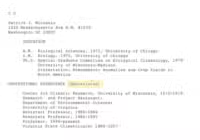
Summary In February 2009, Patrick Michaels appeared before the Subcommittee on Energy and Environment to testify on “The Climate Crisis: National Security, Public Health, and Economic Threats.” He submitted a CV to the subcommittee which came under scrutiny for its omissions regarding Michaels’ financial and professional history with the fossil fuel industry. It also omits […]
Summary An interview with climatologist Patrick Michaels, the current Director of the Center for the Study of Science at the Cato Institute and past president of the American Association of State Climatologists. In the interview, Michaels diminishes carbon’s effect on global warming, dismisses rising global temperatures, and advocates for a “do nothing” public policy approach […]
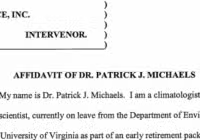
Summary This affidavit from Patrick Michaels, a known climate skeptic with deep ties to fossil fuel interests, reflects his participation in a 2007 lawsuit over Vermont’s changes to fuel emissions standards for new automobiles. Michaels is the Director of the Center for the Study of Science at the Cato Institute, a conservative think-tank created and […]
Summary This is the transcript of a moderated debate between Alan Robock, a climatologist from the University of Maryland and Patrick Michaels, a climate change skeptic with long standing financial ties to the fossil fuel industry. The topic of the debate was “Must We Act Now To Avert a Climate Catastrophe?” and was part of […]
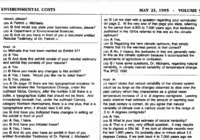
Summary This testimony by Patrick Michaels, then Senior Fellow of Environmental studies at the Cato Institute, was used as expert opinion by Western Fuels Association (“WFA”) before the Minnesota Public Utilities Commission. The hearing was in St. Paul, Minnesota to determine the environmental cost of coal burning power plants in the state. Richard Lindzen, Robert […]
Summary This Global Climate Coalition (GCC) document is a letter from GCC Executive Director John Shlaes to journalists in response to a Washington Post article, in which climate denier Patrick Michaels and climate scientist James Hansen were interviewed about their views regarding natural warming and computer modeling. The industry-funded GCC opposed greenhouse gas regulations through […]
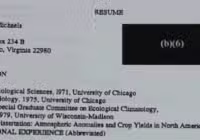
Summary This is a 1990 CV for Patrick Michaels, a known climate skeptic with longstanding financial ties to the fossil fuel industry. Michaels has been an outspoken advocate for industry interests on issues relating to emissions regulation and climate change for decades – this CV documents some of his early connections with climate-denying organizations and […]
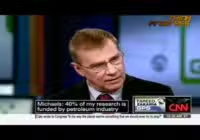
This is an excerpt of a 2010 CNN interview with Cato Institute’s Director of Center for the Study of Science, Patrick Michaels. The interview reflects his admission that roughly 40% of his research funding came from the oil industry. Partial Transcription Zakaria: Let me ask you what people wonder about you, about advocates like you. […]
A partial list of Climate Files posts, organized by date published. To view the post, click the hyperlinked title. The original document is embedded at the bottom of each post. To view the full annotations in DocumentCloud, click the four arrows in the bottom left of the embedded viewing window. From there, the original .pdf […]
Below is an annotated collection of documents gathered through the years amassing evidence of corporate efforts to deny the connection between climate change and extreme weather events. There are two major blocks of evidence: They knew climate change would cause extreme weather: Corporate entities “knew” extreme weather would be an impact of anthropogenic climate change. […]